Monday, April 3, 2023

Protecting the Spinetail Devil Ray


The Spinetail Devil Ray, taken by Julian Renoult 

The Spinetail Devil Ray or Mobula Mobular, is a large ray that resides in tropical and temperate waters. It is an endangered species, but can be found in a wide array of areas in the Oceans across the world. The Spinetail Devil Ray eats tiny marine organisms while swimming, typically things such as plankton, small fish, and crustaceans like other members of the ray family. The Spinetail devil ray is endangered, due to many factors unfortunately. Data from the IUCN Redlist states that their rate of reproduction is very slow compared to many other lifeforms, as they typically have one offspring every 1-3 years, with a 12 month pregnancy phase and have a very low rate of population increase. The average lifespan of a Spinetail Devil ray is around 12 years, with the maximum being 20 years old. The population of the Spinetail Devil Ray is also declining rapidly due to one major environmental issue, bycatch from fisheries. This has resulted in a 50-79% decrease in population over the last 38 years, and this number is declining steadily.


Seaweed Underwater, photo taken by an unknown photographer 
The Spinetail Devil Ray lives in the Ocean biome, specifically in tropical and temperate waters. The Spinetail Devil Ray typically stays in water around 50 meters deep, but has been known to dive to waters over 1,000 meters according to the IUCN Redlist 
An ocean sunset, taken by user Kienvirak
The Ocean covers around 70% of the Earth, but there are many different Oceans with varying temperatures. The Spinetail Devil Ray is found in every ocean except the Arctic Ocean, due to the colder water temperatures there. The Oceans are very wet environments, as they consist pretty much entirely of water. In the Oceans there are
many types of producers such as seaweed, algae, and phytoplankton. Phytoplankton are the most abundant, and they are small microscopic plants floating in the water. Seaweed and algae are also incredibly common and important producers. Some primary consumers of the Ocean are Zooplankton, many kinds of small fish, and crustaceans such as brine shrimp or fairy shrimp, which also serve as food for the Spinetail Devil Ray.
Close up of Phytoplankton, Taken by an unknown photographer


    The most critical threat to the population of the Spinetail Devil Ray is bycatch from fisheries and overfishing in general. Bycatch is basically everything other than the target species that is caught from fishing, for example if someone was fishing for shrimp and they caught a crab, that would be considered bycatch. They are both targeted and caught accidentally through various means. This makes the number of caught Spinetail Devil Rays hard to track exactly, but it is estimated that thousands are caught per year per the IUCN Redlist, which has a major impact on an already dwindling population number. Bycatch is extremely damaging to the environment, as it often involves very long (one mile+)  long nets that drag along the ocean floor capturing anything and everything along the way. Even though they are endangered, they are still sold in some parts of the world such as China, India, and Sri Lanka. There is even a fishery that exists in the Levantinee sea that specifically hunts Spinetail Devil Ray, and has since the 1970’s and was specifically noted by the IUCN Redlist.
The damage from these fishing methods employed by many fisheries should not be understated, as the huge nets capture, kill, and destroy pretty much anything that it comes in contact with. This practice is used all over the world, especially large exporters of fish such as Japan. Overfishing / bycatch is an issue that is continuing to get worse with no signs of slowing down anytime soon which is very scary for the future of lots of ocean life. 
A quick guide to the fishing methods of major fisheries
Photo taken by users Hannah Richie and Max Roser


    While overfishing / bycatch is relatively exclusive to the ocean, it is similar in a way to to deforestation. Deforestation on an extreme scale is just taking every tree from a forest, and leaving the land barren, missing tons of important elements of the ecosystem that the trees provided such as homes for animals and food for others, which can lead to population issues. Overfishing is similar as it is resulting in entire species being wiped out due to home destruction and mass killings. 

Here in Keene, New Hampshire we don’t have a fishery, but that doesn’t mean that someone can’t do their part locally to help against overfishing. Overfishing is a large issue that is deeply rooted in the fishing industry as a whole, which involves a whole lot of products, and companies. My recommendation would be to consume minimal products that come from the fishing industry, and if you do, make sure they are from a company that you can trust and have done research on. I've done some research online and found there are many resources that are dedicated to writing guides to help someone choose the most environmentally sustainable options for their region, which shows what is acceptable to eat in your region, and also what is unacceptable due to harmful farming practices. The best one I found was a helpful collection of guides written by the Monterey Bay Aquarium, called “Seafood Watch”.
Sustainable Seafood by region, Created by the Monterey Bay Aquarium

This site has excellent information for every region in the United States. Resources such as this one are extremely useful for educating yourself and others on the food you consume, and can have a major impact on the environment if adopted by folks locally. I would also recommend buying your sources of protein from a reputable and local source, as you get to give back to the community while also helping yourself at the same time by getting fresher product! 


Sunday, March 19, 2023

A Quite Snowy Walk

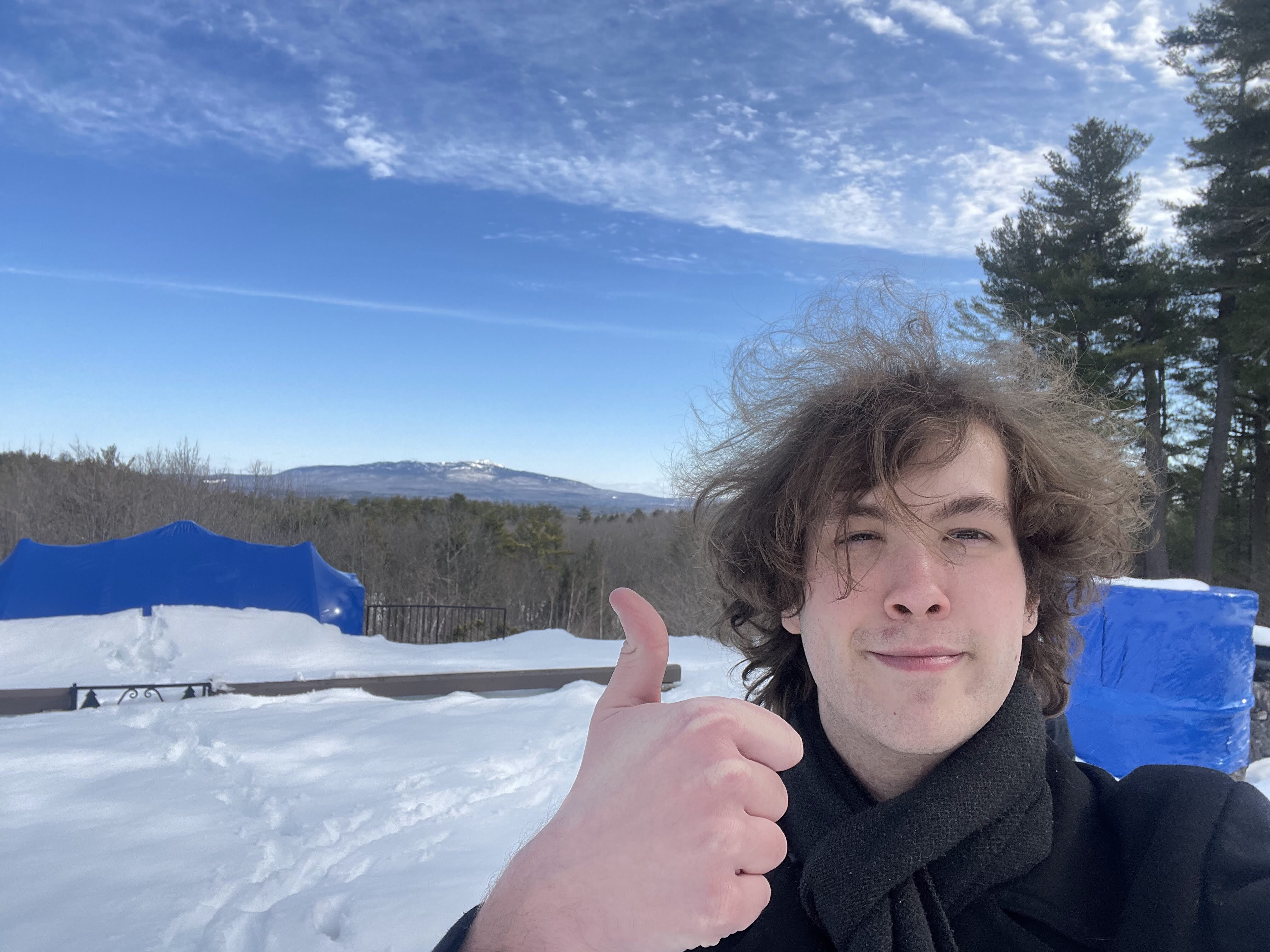
     I decided to spend some time outside after the massive storm New Hampshire and many other places got this week. I wanted to take in what is probably the last major storm for this winter, and what was probably the largest storm we've gotten in a few years. I ended up going to the Cathedral of The Pines in Rindge, NH. I grew up in Fitzwilliam, NH which is right next door to Rindge so this was always a place I would go to walk the many trails on the grounds. I even got my senior pictures done there! I ended up dragging my cousins along to go with me, which was really nice because I don't get to spend a ton of time with both of them at the same time now that we are older.

A photo of me, with the beautiful Mount Monadnock
in the background (3/18/23)
The area was still extremely snowy, and the Rindge area got a TON more snow than the Keene area, which I was severely underestimating. I don't believe the images exactly do the amount of snow justice, they easily got over two and a half feet of snow. This led up to just end up doing the tiny 1/4 of a mile walking path through the grounds instead of the long trails in the woods. The walk was beautiful, and I've only ever spent time there in other seasons so the large amount of snow really gave it a unique vibe that I've never seen at this place, it was very calm and we were one of the first people to have walked on the grounds with the snow so we were out there kind of making our own trails, which added an extra layer of fun. I included a few photos of some of the spots that caught my eye, most of the memorials and landscape was completely covered in snow but it was a marvel in itself that there was that much snow. I'd like to come back here and take "before and after" shots of when the snow melts and see how different the landscape is, and also maybe I can go back and figure out the name of that religious statue. I didn't have my gloves so I didn't want to bury them in the snow, but its a good reason to go back. The Women's Memorial Bell Tower looks beautiful year round though, as it is quite tall and raised a bit to hide from the snow. Also there are many marriages here every year due to the amazing view of Mount Monadnock, but I've never been to one personally. 

A photo of a religious figure (3/18/23)

The backyard seating area buried in snow(3/18/23)


There is a massive hill on a side of the grounds, which is a good community spot for sledding among the local children and parents. There was a large herd of children there at the hill when we went as it was prime sledding weather. It made me wish I had brought a sled and made me a bit nostalgic for times when I was a bit younger.

The Women's Memorial Bell Tower  (3/18/23)
I had chosen this place because I have a ton of nostalgia about this place, and also I feel like it represents the local community extremely well as it is universally known by the community and is a safe space for the "vulnerable" population, being the elderly and disabled people in the community. Many of our talks in class are about communities of people and places that are important to the community, and this place reminds me of a place that the community would certainly fight over in the case of any environmental misconduct. There have been quite a few vandalisms here over the years, and every single time it happens there is an incredible community response and I guess it surprises me because I feel that is becoming more and more rare in this age. The fact that this short walk had me thinking of all these things is amazing, and I truly believe that taking Environmental Studies classes has changed my perspective of many things in nature and I'm extremely glad I decided to take them alongside my Computer Science classes. 


Monday, February 13, 2023

Application Assignment #1


Jenny Hopkinson, while working at media company Politico, spent some time researching the American soil health and if modern agriculture techniques were damaging the extremely important soil microbiome. The article essentially breaks down the most popular modern farming method, tillage. Tillage is extremely problematic because when this is done, the soil gets broken up, turned and hit with some form of chemical fertilizer which extremely damages the soil microbiome. By destroying the microbiome in the soil, you are destroying the many microorganisms inside the soil which are directly related to soil health. Without those microorganisms, the crops suffer resulting in lower yields and poor quality. This is becoming more and more common every year in the United States, resulting in less and less healthy soil at an alarming rate.


Now this is extremely alarming information, due to the fact that once the soil is unusable, all life struggles to exist in that space. If agriculture methods stay the same as they have been, we are looking at a grim future in terms of food and oxygen which are both essentials to life. There are solutions that have been researched and tested: one of those is known as cover-cropping. Cover cropping is essentially just rotating crops and making sure to plant secondary plants like legumes and vegetables on exposed soil between the main crops.


Humans in the agriculture industry are often forced to plant the same crop over and over, year after year due to the government subsidy program that the government pays out for production of a specific crop. This gives the farmers a monetary incentive (While a low one), this has made it hard to get farmers to change their methods that their families and friends have been doing for decades. Also many rely on this money from the government to make a living, so it is a sort of pit farmers have fallen into.


                                           Image of a tractor tilling soil, taken by Keith Weller from the U.S Department of Agriculture


---------------------------------------------------------------------------------------------------


Deforestation is another major environmental issue that is plaguing many beautiful places across the globe. Deforestation is the act of removing all the natural trees and brush in an environment to clear it out for business purposes, logging purposes or natural resource gain. Oil drilling is one of the most common reasons for deforestation in the modern day as it is one of the most sought after resources on Earth. This is becoming a major problem that is getting worse and worse every day in the Amazon Jungle. The Amazon Jungle is an amazingly biodiverse place and one of the most beautiful but dangerous places in the world, but is cherished and loved by many. Large corporations come in and clear the land of the Amazon for oil, and at the same time completely destroy and pollute the local ecosystem with no regards to life or the people living there in the Amazon Jungle. The combination of the unregulated logging and incredibly messy oil drilling, completely destroys the natural balance and leaves a huge impact on the environment. This is just the beginning, and over time without a solution or a stop to this it will continue to get worse, to an irreversible level.


This problem is a very large one in the same way that the farming methods in the United States are, and they are surprisingly similar as they both completely destroy key components of the environment. As the soil tilling breaks down the soil microbiome and prevents life, the oil taints everything it touches, and seeps into the ground and local ecosystem causing serious repercussions.


Although, much like the farming methods, there are much more sustainable ways to clear land and not completely destroy the ecosystem. There are entire groups that are dedicated to this practice known as “Sustainable Forestry”, which consists of applying and educating about sustainable forestry practices and key ideas like how to maintain forest health. This article was written by James C. Finley, a professor of forestry explains what sustainable forestry is, and how it may be interpreted to different people.


                                       Image of deforestation of a rainforest taken by Danielle Gidsicki on wikipedia

-----------------------------------------------------------------------------------------------------------------------------


New Hampshire, where I am from, is a relatively small state with massive forests and many local farms. These issues that I have discussed in this post are extremely important, and even in a small state like New Hampshire, we can do our part to not contribute to the problems and to actively find solutions to better sustain our local ecosystem.


In New Hampshire there are many local farmers in nearly every town, and purchasing goods from them directly at a local farmers market is a fantastic way to give back to the local economy and support farmers that are growing their own vegetables without using massive machines or huge amounts of pesticides. But that does not mean that there are not some farms in New Hampshire that use these farming techniques, so the best thing you can do is educate yourself a bit on your local economy and where your food is really coming from.


Another excellent way to promote farming techniques is something that is a little different, but is a brilliant idea. UMass Amherst, a college relatively close to New Hampshire, started an initiative on campus to create permaculture gardens around some of the empty spaces on campus. Permaculture is essentially where you focus on building the soil that you plant your crops in, through one of many different environmentally friendly ways such as composting. The food produced in these gardens on campus end up being used in meals on campus! I think this is an amazing idea, and more places should look into doing something such as this. There is an excellent documentary about this, which you can find below this post. Overall I believe that if more colleges started doing this, it would set a massive standard for environmental health and lead to many young people heading into the future with a positive outlook on sustainability.


                                            Link to the UMass Documentary on Youtube uploaded by Ryan Harb


Sunday, February 5, 2023

My Favorite Place in Nature (HW4)


This is my favorite place in nature, Mount Monadnock.  This place is my favorite because it really does feel like you accomplished something when you hike a mountain, especially one the size of Monadnock. You feel very small on the top, and it has some very good spots to eat lunch and reflect for a bit. I find it incredible relaxing on the top, the air is very pure and the people are always incredibly friendly. I even had a friend who worked on the mountain and I would run into him sometimes. Living right down the road from a mountain like this is absolutely amazing, and remains one of the reasons why I want to stay in                                                         New Hampshire in the future

-Top image taken by me in October of 2018 from the Peak of Gap Mountain

-Right image taken by me in May of 2022 at the top of Mount Monadnock on a rather nice day


- Bottom image taken by Wikipedia user skdp with a photosphere


Wednesday, February 1, 2023

My Favorite Place (In-Class Test)


                                            Source This is a photo of Mount Monadnock, taken from Bald Rock by user Jonwmcinenrey

Monday, January 23, 2023

Test Post

 This is a test

 This is a test

 This is a test

This is a test

 This is a test